Home energy audits aren’t seasonal. They can be done year-round and still provide clear guidance on comfort, efficiency, and indoor air quality.
Thermal imaging is one of the tools we use during a home energy audit. It works best when there’s a strong temperature difference between indoors and outdoors, which is why Maine winters make problems easier to spot.
If one room in your home always feels colder than the rest, winter is often the best time to find out why.
Give us a call at 207-594-2244, or schedule a home energy audit online.
Since 2006, Evergreen Home Performance has completed more than 6,000 projects for homeowners across Maine. We’re Maine’s most trusted insulation experts, known for our whole-home approach, deep experience with Efficiency Maine rebates, and a commitment to lasting comfort and energy savings.
Why cold Maine weather makes problems visible
Here in Maine, long heating seasons and sustained cold put real pressure on a home’s insulation and air sealing.
Thermal imaging works by detecting temperature differences across surfaces. When it’s cold outside and warm inside, those differences become much more pronounced.
That contrast makes hidden issues – such as missing insulation, air leakage, and thermal bridging – stand out clearly on an infrared camera.
In milder weather, those same issues may still be present, but they’re often harder to interpret. During a Maine cold snap, they tend to show themselves unmistakably.
How thermal imaging actually works
An infrared (IR) camera doesn’t see air movement or insulation directly. Instead, it shows surface temperatures.
- Colder colors indicate areas where heat is escaping or cold air is intruding
- Warmer colors indicate surfaces retaining heat more effectively
When indoor and outdoor temperatures differ by at least 15–20 degrees, infrared images become much more reliable and easier to interpret.
That’s why winter conditions across Maine – from Portland to Rockland and beyond – are ideal for using thermal imaging to pinpoint comfort and efficiency problems.
Real-world examples: what winter reveals in Maine homes
The following examples are common in Maine houses and illustrate why cold-weather imaging is so useful.
Example 1: Heat loss at a bump-out or cantilever


Thermal image: A dark band appears across the floor or wall area of a bump-out, indicating significant heat loss compared to surrounding surfaces.
What it means: Bump-outs often extend beyond the main foundation and can be difficult to insulate properly. In winter, missing or compressed insulation in these areas becomes immediately visible.
Example 2: Cold air leaking where walls meet floors
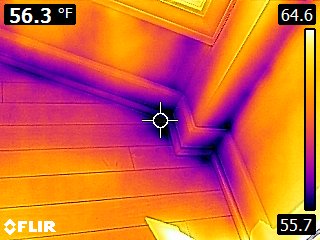

Thermal image: Colder temperatures concentrate along the base of an exterior wall.
What it means: This pattern is a classic sign of air leakage, often at rim joists or framing transitions. Cold outdoor air is being drawn into the home, making floors and nearby rooms feel chilly.
Example 3: Air leakage around windows


Thermal image: A cold corner or edge appears around a window frame.
What it means: Even good windows can leak air if they weren’t properly air sealed during installation. Cold weather exaggerates these leaks, making it easier to pinpoint where improvements are needed.
The best time to schedule thermal imaging
Winter offers the strongest temperature contrast, which makes infrared images easier to interpret.
In cold Maine weather, thermal images often show deep blue or purple areas that clearly highlight:
- Where cold outdoor air is leaking into the home
- Missing or underperforming insulation
- Thermal bridges in framing, cantilevers, or additions
In warmer months, those same issues may still appear, but they often show up as lighter color variations. The problems are still there – it’s just harder to tell how severe they are.
Blower door testing helps exaggerate air leakage at any time of year, and we often use it alongside thermal imaging. Even so, thermal imaging is most visually revealing during the winter months.
If a bedroom, addition, or living space in your Maine home always feels colder than the rest, winter is often when the clearest answers emerge.
Ready to take the next step?
Thermal imaging is most powerful when paired with a full home energy audit. At Evergreen Home Performance, we use infrared imaging alongside blower door testing and a whole-home, building-science approach to diagnose comfort, efficiency, and moisture issues.
You don’t have to wait for winter to get started – but if your home struggles to stay comfortable in cold weather, now is an ideal time to see what’s really going on.
Schedule a home energy audit or call 207-594-2244 to talk with our team.