Skip to content

If you found water in your basement after a storm, this guide covers what to do right now, why it happened, and what it takes to make sure it doesn’t happen again. In older Maine homes, water after a heavy rain is rarely a one-time event.
If you’ve come down cellar after a storm and found water on the floor, there are two things to know.
The first is what to do right now. The second is what this actually means for your home, because in older Maine homes, water after a heavy rain is usually not a one-time event.
Table of contents
- What to do right now
- Why basements flood after rain in Maine
- Why it will happen again
- What a permanent fix looks like
- When to call someone
- Common questions
What to do right now
Before anything else:
- Stay out of standing water if there’s any chance electricity is involved. Check that your breaker panel and any outlets near the water are dry before going in.
- Turn off power to the affected area if you’re not certain it’s safe.
- Document what you see. Photos of the water, where it’s entering, and how high it got will help anyone you bring in to assess the situation.
If you’re dealing with a damp floor, seepage along a wall, or a small puddle near the base of the foundation, you can usually handle the cleanup yourself. A wet/dry vac, some towels, and a fan are enough to address the immediate moisture. Note where the water came in. That detail matters later.
If you have several inches of standing water, soaked contents, or water that’s reached drywall or the subfloor, that’s a job for a water remediation company. They have the equipment to extract water quickly, dry out the structure, and get ahead of mold. A quick search for “water damage restoration” will turn up local options.
Either way, the cleanup is the short-term problem. The reason water got in is the one worth solving permanently, and that’s where we come in.
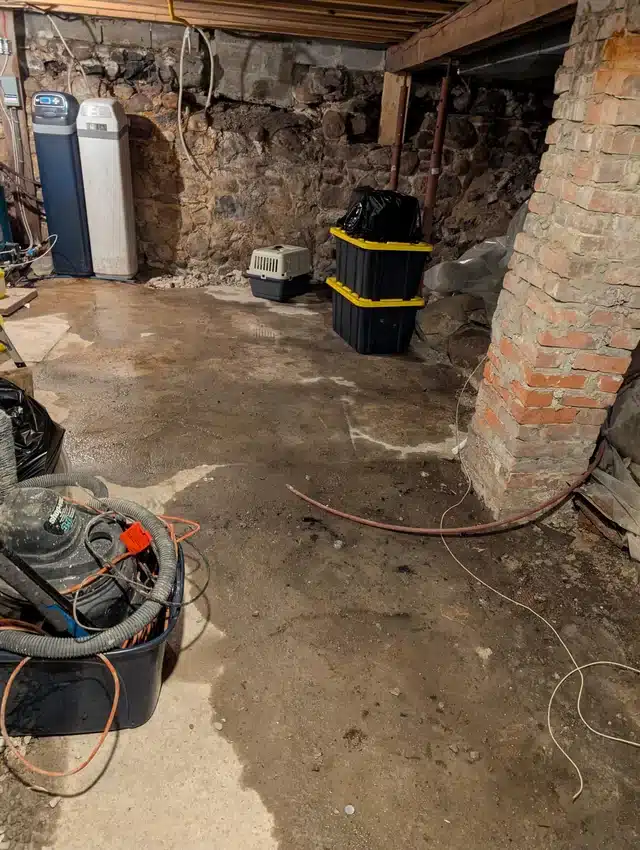
Why basements flood after rain in Maine
Water in the basement after rain isn’t usually a freak event. It’s a sign that something structural is working against you.
Heavy rain or snowmelt saturates the soil around the foundation. That water creates hydrostatic pressure – it presses against the walls and floor from the outside. In newer homes with poured concrete foundations, this pressure has fewer ways in. In older homes with fieldstone, rubble, or uneven block walls, the water finds a way.
The most common entry points:
- The seam where the floor meets the wall (the cove joint)
- Cracks or gaps in the foundation wall
- Water wicking through porous fieldstone or rubble
- Floor drains that back up under pressure
Fieldstone foundations in particular were never designed to keep water out. They were built to hold the house up. Water moving through them after a storm is working exactly as the physics would predict, and no amount of crack-filling or a sump pump alone will change that.

Why it will happen again
This is the part most homeowners don’t hear until they’ve already tried a cheaper fix.
A single heavy rain event didn’t create the problem. It revealed it. The groundwater pressure, the soil conditions, and the foundation type were already there. They’ll be there next spring too, and the spring after that.
Temporary measures like crack sealant, plastic sheeting, or a basic dehumidifier can reduce symptoms in very mild cases with newer construction. For older Maine homes with fieldstone or rubble foundations, they typically don’t hold. The water pressure doesn’t go away, and eventually it finds its way back in.
Lots of homeowners come to us a year or two after trying a smaller fix first. In the meantime, wet framing and damp conditions create the right environment for mold, which adds to the scope and cost of the project. Solving it right the first time is almost always less expensive than addressing it twice.
What a permanent fix looks like

Solving a wet basement in an older Maine home usually means a system designed to manage water, not just resist it.
Depending on what’s causing the problem, that system might include:
- A French drain to collect groundwater along the basement perimeter and route it away from the foundation
- A sump pump to move that collected water safely outside before it can flood or cause damage
- A vapor barrier to control moisture movement through walls and floors
- Air sealing to stop damp basement air from moving into the living space above
- A dehumidifier to manage ongoing humidity levels once bulk water is controlled
One thing worth knowing: waterproofing done wrong can actually make radon worse. If drainage trenches aren’t properly sealed, they can open a pathway for soil gases to enter the home. Evergreen designs systems to move groundwater while keeping those pathways closed, which is why radon-safe installation is part of how they approach every project.
The right combination depends on how water is getting in. For a home that flooded after rain, a French drain and sump pump are almost always part of the answer.
For a realistic sense of what this costs for older Maine homes, the cost guide here walks through typical price ranges and what drives them: How much does it cost to fix a wet basement in Maine?
Not sure what caused your flooding? We’ll walk through it with you at no charge.
Schedule a Free ConsultationWhen to call someone
If your basement flooded once after rain, it’s worth having someone look at the space, especially before the next storm.
A free walkthrough costs nothing, and it’s the only way to know what’s actually causing the problem. We’ll look at where the water is entering, the condition of the foundation, how moisture is moving through the space, and what system would address it at the source.
If the problem is minor, we’ll tell you that honestly. If it’s something that needs to be addressed, we’ll tell you what’s involved and what it would cost.
Call 207-594-2244 or schedule a free consultation online.
Common questions
Will my basement flood again after the next heavy rain?
In most cases, yes — if the underlying drainage issue isn’t addressed. One flooding event is usually a sign that water has a path in. Without changing the drainage situation around the foundation, the same conditions will produce the same result.
Can I fix a flooded basement myself?
You can handle the immediate cleanup with a wet/dry vac and fans. For the underlying cause — groundwater pressure, porous foundation walls, drainage failures — the fix usually involves installing a French drain and sump pump, which is a significant construction project. Most homeowners hire a contractor for this.
Does homeowners insurance cover basement flooding?
It depends on the cause. Most standard homeowners policies cover sudden accidental water damage (like a burst pipe) but not flooding from groundwater or heavy rain. Flood insurance is a separate policy and generally needs to be purchased before an event. It’s worth checking your specific coverage, but most homeowners with wet basement issues from rain pay out of pocket or finance through programs like Green Bank.
Is it worth fixing if it only happened once?
One flood is worth taking seriously, especially in an older home. Water damage compounds over time — wet framing, mold, and structural deterioration are slow problems that become expensive ones. And the conditions that caused one flood don’t usually improve on their own. A free consultation is the easiest way to understand what you’re dealing with.
Can fixing my basement create a radon problem?
It can, if the drainage system isn’t designed carefully. Cutting a trench around the basement perimeter and leaving it unsealed can open a pathway for soil gases to enter the home. Evergreen installs sealed drainage systems that move groundwater while keeping those pathways closed, and coordinates with radon mitigation when needed. If radon is already a concern in your home, mention it during the consultation.
Talk to someone about your basement
Since 2006, Evergreen Home Performance has helped thousands of Maine homeowners fix moisture problems at the source. If you found water in your basement after a storm, we’ll tell you honestly what caused it and whether it’s likely to happen again.